DU SOL BLIS Admission 2026: Eligibility, Fees, Admission Process, Syllabus & Career Guide
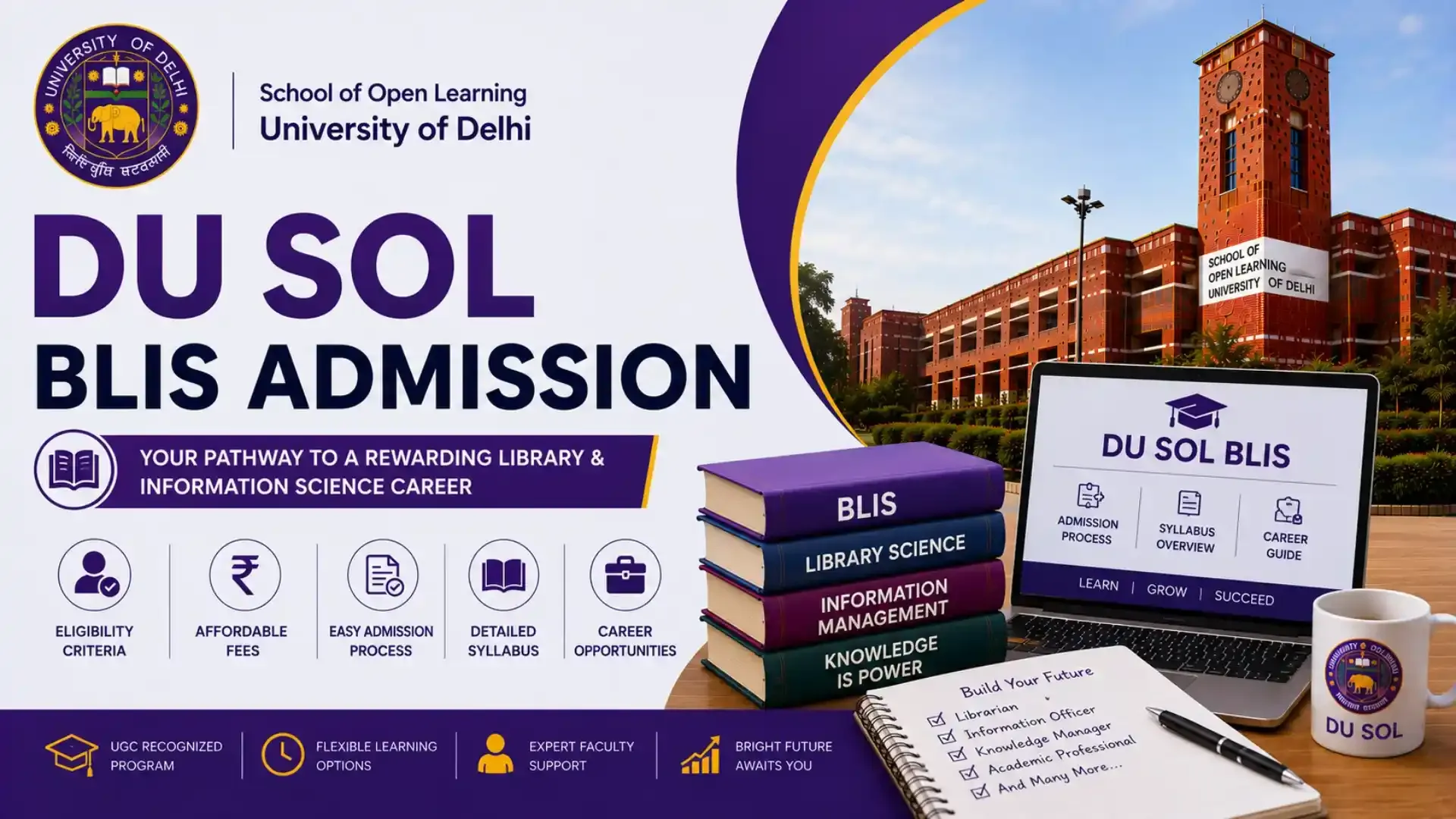
The DU SOL BLIS program provides an opportunity for Graduates to continue with the Bachelor of Library and Information Science in Distance Education. The program aids students in developing competencies like library administration, cataloguing, information organization, and management of digital resources. Read this guide for complete details of the DU SOL BLIS Admission process including DU SOL BLIS Eligibility,Fees,Admission Procedure, Syllabus, Career Prospects, and so on.
DU SOL BLIS Course Highlights
Particular | Details |
Course | Bachelor of Library and Information Science (BLIS) |
Duration | 1 Year |
Learning Mode | Distance Learning |
Eligibility | Graduation |
Total Fees | As Prescribed by DU SOL |
Degree Awarded | BLIS Degree |
What Is the DU SOL BLIS Course?
Course Overview
The DU SOL Distance BLIS Course introduces students to library functioning, information processing, and new-age information systems.
Programme Objectives
This Course is designed to create expertise and efficiency for handling library classification, cataloguing, managing a library, and offering services to users.
Learning Outcomes
Students become equipped to categorize, protect, identify, and maintain information and other related materials both in printed and digital forms.
Who Should Join BLIS?
The BLIS programme can be completed by any graduate who is looking for a career opportunity in library sciences or information systems at universities, colleges, and other institutions.
Why Choose DU SOL for BLIS?
Delhi University Brand Value
The degree will be readily accepted at higher learning institutions and for jobs.
Low Course Fees
Get quality education for the cost of BLIS.
Convenient Distance Learning
Work, while studying.
UGC-Approved Degree
The Bachelor of Library and Information Science is approved under UGC distance education as the case may be.
Career-Oriented Syllabus
You will gain both theoretical knowledge of the field and acquire the skills needed in library work.
About Delhi University School of Open Learning (DU SOL)
University Overview
DU SOL is a distance learning institution of the University of Delhi.
UGC Guidelines
We abide by the UGC Guidelines for recognised Distance Education Programs.
NAAC
Accreditation Delhi University has been recognised by the NAAC.
Support Services for Students
The students will get academic support, online resources, and examination help.
Study Material
We provide comprehensive online study materials and resources.
DU SOL BLIS Eligibility Criteria 2026
Criteria | Requirement |
Educational Qualification | Bachelor's Degree |
Minimum Marks | 40%(As per norms) |
Reservation Policy | Applicable |
Age Limit | No Upper Age Limit |
Working Professionals | Eligible |
DU SOL BLIS Admission Process 2026
Step 1: Online registration
Enter your valid email ID and contact no for registration.
Step 2: Fill application form
Submit all personal details and education details, and contact details correctly.
Step 3: Upload documents
Download the required documents as given and upload the same.
Step 4: Pay Admission fee
Submit your application by paying the admission fees.
Step 5: Take Printout
Take the hard copy of your admission form and save it for further uses.
Important Dates for DU SOL BLIS Admission 2026
Registration Starts
05-Dec-2023 Apply Online Starting Date Registration commences as per the admission schedule published by DU SOL.
Last Date to Register
Apply by the last date of registration.
Verification of Documents
2-3 days after application submission documents are verified.
Last Date for Fee Payment
Fee must be submitted by the specified date.
Start of Classes
Classes commence as per the academic calendar
Important Dates
Event | Timeline |
Registration Start | June 2026 (Expected) |
Last Date to Apply | August 2026 (Expected) |
Document Verification | After Submission |
Fee Payment Deadline | As Scheduled |
Academic Session | As Per Academic Calendar |
Documents Required for DU SOL BLIS Admission
Required Documents Checklist
Document | Requirement |
Graduation Marksheet | Mandatory |
Identity Proof | Mandatory |
Category Certificate | If Required |
Passport-Size Photograph | Mandatory |
Signature | Mandatory |
DU SOL BLIS Fees Structure
Complete Fee Structure
Fee Component | Details |
Registration Fee | ₹500 (UR/OBC-NCL/EWS), ₹300 (SC/ST/PwBD) |
Tuition Fee | Included in the total course fee. |
Examination Fee | Included in Course Fee |
Other Charges | As Applicable |
Refund Policy | As Per University Rules |
DU SOL BLIS Syllabus (Semester-Wise)
Semester | Major Areas |
Semester I | Library Science Fundamentals, Cataloguing, Classification |
Semester II | Library Management, Digital Libraries, IT, Research |
Core Subjects Covered in the DU SOL BLIS Course
Subject | Learning Outcome |
Library & Information Society | Understand Library Systems |
Knowledge Organization | Organize Information |
Library Classification | Classify Resources |
Cataloguing | Prepare Catalogues |
Information Services | Deliver Information Services |
Library Management | Manage Library Operations |
Information Technology | Use Library Software |
Digital Libraries | Manage Digital Resources |
Research Methodology | Conduct Basic Research |
Practical Training | Gain Practical Skills |
Learning Methodology at DU SOL
Learning Component | Purpose |
Self-Learning Material | Independent Study |
LMS | Online Learning Support |
Academic Support | Faculty Guidance |
Assignments | Continuous Assessment |
Practical Sessions | Skill Development |
Examination System | Performance Evaluation |
Examination Pattern & Evaluation
Internal Assessment
Assignments and all internal activities contribute towards the total evaluation.
Practical Examination
Students may have a practical evaluation on practical library science aspects.
Semester-End Examination
University end-of-semester exams to determine knowledge and skills.
Passing criteria
Candidates must obtain the minimum marks specified by the university for passing.
Grading System
The result will be calculated on university standards for grading.
Marks Distribution
Assessment Component | Weightage |
Internal Assessment | 30 Marks (30%) |
Practical Examination | 70 Marks (Practical Courses Only) |
Semester-End Examination | 70 Marks (70%) |
Passing Criteria | Minimum 40% Marks |
Grading System | 10-Point Grading System (CBCS/NEP) |
Skills You Gain Through the BLIS Course
1. Information Management:
Acquiring a skill for organizing and managing information.
2. Library Automation:
Learn the usage of advanced library automation software.
3. Cataloguing Skills:
Develop the ability to classify and prepare catalogues.
4. Digital Resource Management:
Acquire the skill of managing online resources/collection.
5. Research & Documentation:
Improve skills of reference service, research, etc.
6. Communication skills:
Learn a skill to improve communication and service to the users.
.
Career Opportunities After DU SOL BLIS
Job Role | Career Area | Average Salary* |
Librarian | Academic/Public Libraries | ₹3–6 LPA |
Assistant Librarian | Educational Institutions | ₹2.5–4.5 LPA |
Library Information Assistant | Libraries | ₹2–4 LPA |
Digital Library Executive | Digital Libraries | ₹3–5 LPA |
Documentation Officer | Corporate/Research | ₹3–5 LPA |
Information Analyst | Information Services | ₹4–7 LPA |
Records Manager | Organizations | ₹3–6 LPA |
Archivist | Archives | ₹3–6 LPA |
Knowledge Management Executive | Corporate Sector | ₹4–7 LPA |
Academic Library Professional | Universities | ₹3–6 LPA |
Government Job Opportunities After BLIS
Central Universities
Central universities recruit library posts.
State Universities
State universities conduct regular recruitment of library professionals.
Public Libraries
Government jobs for library graduates are offered in the public library systems.
Government Departments
A few government departments require competent library personnel.
UPSC & SSC Library Posts
Eligible students can apply for library posts in the government sector.
Government Job Roles
Sector | Opportunities |
Central Universities | Library Posts |
State Universities | Library Services |
Public Libraries | Librarian Roles |
Government Departments | Information Services |
UPSC & SSC | Library Positions |
Higher Education Options After BLIS
Post BLIS
The Study Options for higher education include the DU SOL Distance MLIS (Master of Library and Information Science). It is one of the most sought-after postgraduate courses among BLIS holders.
Postgraduate Diploma Courses
There are many specialised courses for enhancing the professional skills of the BLIS holders.
Research Programs
For candidates who are aiming for higher education in an academic sphere of study.
Professional Certification
Certification courses in certain specific technical subjects are also popular among library science holders.
Top Recruiters for BLIS Graduates
Universities
Universities recruit library professionals for the university library.
Colleges
Colleges require BLIS graduates for library services.
Government libraries
Government libraries hire library professionals.
Research institutes
Research institutions appoint information management experts.
Corporate knowledge centers
Corporate bodies look for professional expertise in the fields of knowledge management and document management.
Publishing house
A publishing house recruits professionals for the services of the documentation & information service.
DU SOL BLIS vs IGNOU BLIS
Comparison Table
Feature | DU SOL BLIS | IGNOU BLIS |
Eligibility | Graduation | Graduation |
Fees | ₹11,820 (Approx.) | ₹9,000 |
Curriculum | NEP-based BLIS Curriculum | CBCS/Updated BLIS Curriculum |
Learning Support | Online & SLM | Online & SLM |
Degree Recognition | UGC-DEB & University of Delhi | UGC-DEB & IGNOU |
Career Opportunities | Libraries, Universities, Research & Corporate | Libraries, Universities, Research & Corporate |
DU SOL BLIS vs Regular BLIS
Learning Mode
DU SOL follows distance learning, while regular programmes require classroom attendance.
Fees
Distance education is generally more affordable.
Flexibility
In case of working professionals, DU SOL programmes are more flexible.
Practical Exposure
In the case of regular programmes, practical classes are usually held in classrooms.
Degree Value
Both degrees support higher education and employment opportunities.
Who Should Pursue the DU SOL BLIS Course?
Graduate who wants to make their career
in the library field. This UG & PG course can be chosen by all graduates who wish to make their career in library and information sciences.
Working professionals.
For working professionals who want to pursue higher education with great flexibility, this is a great choice.
Teachers and academicians
This course would be very handy for those who are teachers and academicians and want to get acquainted with library science.
Government job aspirants
Candidates applying for government jobs that are library-specific can get good results.
Information management professionals
For those professionals who work with information systems and documentation work, it’s worth choosing this course.
Advantages and Limitations of DU SOL BLIS
Main benefits
The program offers flexibility of studying and a low cost to achieve a certified degree that is both good for university studies and work.
Risks to consider
The student needs to be able to exercise a strong level of discipline, and some practical components might be lacking when compared to on-campus.
Pros & Cons Table
Aspect | Pros | Cons |
DU SOL BLIS | Flexible learning, affordable fees, recognized degree | Self-study based, limited classroom interaction |
Is DU SOL BLIS Worth It in 2026?
Table: ROI Analysis
Factor | Analysis |
Degree Recognition | Recognized |
ROI | Good |
Career Growth | Positive |
Government Job Scope | Available |
Long-Term Benefits | Strong Career Progression |
Latest Updates on DU SOL BLIS Admission 2026
Admission Notifications
Candidates should regularly check the official admission portal for new notifications.
Fee Updates
The latest fee structure is published with the admission notification.
Key Eligibility changes to note
Applicants need to check the updated eligibility before making an application
Academic Calendar
Important academic dates are announced by DU SOL for each admission session.
Conclusion
Through the DU SOL BLIS admission procedure, the degree holders will be awarded an internationally acclaimed Bachelor of Library and Information Science degree through distance education, which can easily be managed alongside their regular jobs. The DU SOL BLIS course fee is very low, the subject matter is designed according to the latest job industry needs and there are a number of employment prospects in the relevant fields.