DU SOL BLIS Admission 2026: Eligibility, Fees & Admission Process
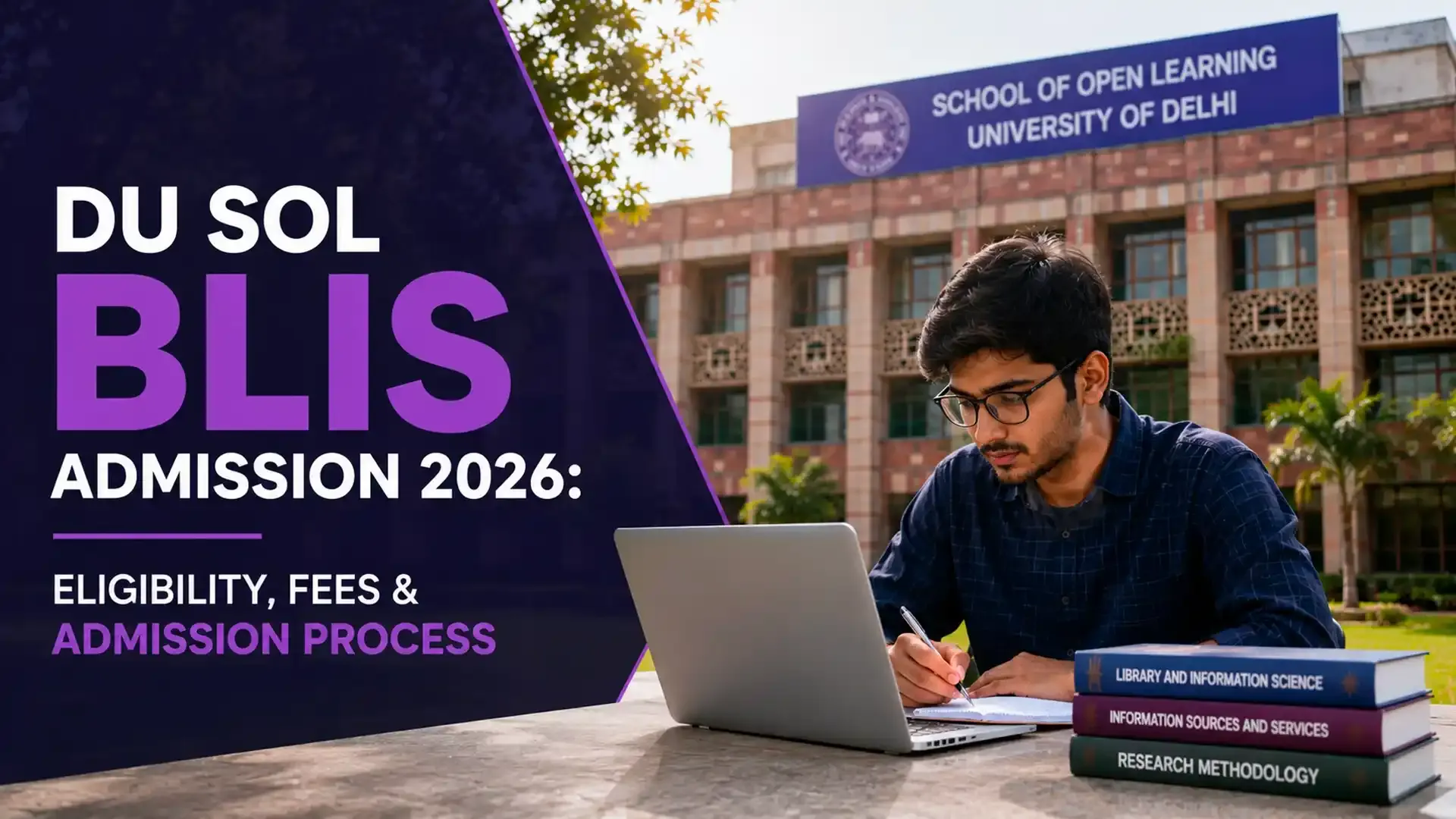
If you're a graduate looking to move into library and information science without giving up your job or daily routine, du sol blis admission is worth a closer look. It's built for people who want to work with libraries, information systems, digital archives, and documentation, all without the pressure of attending regular classes. What makes bachelor of library and Information Science DU SOL stand out is the combination of a low fee, a flexible study schedule, and a degree that actually carries the University of Delhi's name. In this guide, we'll walk you through du sol blis fees, eligibility conditions, the syllabus, and what kind of jobs you can expect afterward.
What is the DU SOL BLIS Course?
Think of du sol blis admission as a bridge course for graduates who already have a degree in some other field but want to add a professional qualification in library science. It's run by the School of Open Learning, which functions under the University of Delhi, and it focuses on the practical side of running a library — how information gets organised, stored, retrieved, and shared with the people who need it.
Course Overview
DU SOL bachelor of library and information science BA. LLB DU -This degree is not purely academic and prepares you for the professional world - cataloging, classifying, functioning of a digital library, Information storage and retrieval - the mechanism. It is open for graduate degree from any stream.
Course Duration
One thing students appreciate about DU SOL BLIS admission 2026 is that it doesn't drag on — the entire programme wraps up in a single year, which is shorter than most professional distance courses.
Learning Mode
Everything tied to DU SOL BLIS admission, from the coursework to the study material, is delivered through Open and Distance Learning. That means you study largely on your own schedule, with occasional contact classes and DU SOL Assignment Last Date Instructions to keep you on track.
Degree Recognition
Because this comes from the School of Open Learning under the University of Delhi, the degree you get after DU SOL admission holds the same weight as any other DU degree, and it's recognised by UGC-DEB, so there's no ambiguity about its validity.
Programme Highlights
Particular | Details |
University | University of Delhi |
Institution | School of Open Learning (DU SOL) |
Programme | Bachelor of Library & Information Science (BLIS) |
Duration | 1 Year |
Learning Mode | Open & Distance Learning |
Eligibility | Bachelor's Degree |
Recognition | UGC-DEB Approved |
Why Choose DU SOL BLIS?
There's no shortage of library science courses out there, so why do so many students still pick du sol blis admission? Mostly because it checks three boxes at once — it's affordable, it's flexible, and it comes from a university whose name actually means something on a resume.
Affordable Fee Structure
If you compare du sol blis fees against what private colleges charge for similar programmes, the difference is noticeable. This alone makes the course accessible to students who might otherwise skip a professional qualification altogether.
Flexible Learning
Since there's no rigid classroom attendance requirement, du sol blis admission genuinely fits around a job, a family, or whatever else is already taking up your time.
Delhi University Degree
There's a certain trust that comes with a Delhi University tag on your certificate. When you complete du sol blis admission, that's exactly what you walk away with.
Library & Information Science Career Opportunities
Once you finish bachelor of library and information science at DU SOL, doors open into school libraries, university libraries, corporate information cells, and research documentation units.
Suitable for Working Professionals
A lot of people enrolling in du sol blis admission are already employed somewhere and are simply using this course to add a relevant qualification without quitting their job.
Government & Academic Job Opportunities
School and college authorities, besides libraries can approach libraries and also government libraries generally search for people who completed any course library science programme which have drawn many students who wish to seek du sol blis admission 2026 .
DU SOL BLIS Eligibility Criteria 2026
Before you get too far into planning, it's worth going through the du sol blis admission 2026 eligibility rules properly — a lot of applications get stuck simply because someone skipped this step.
Educational Qualification
You'll need a bachelor's degree from a recognised university. That's the baseline requirement for du sol blis admission.
Minimum Marks Requirement
The minimum percentage generally follows standard University of Delhi guidelines, though it can shift slightly from year to year, so it's best to check the official notice before applying for du sol blis admission 2026.
Category-wise Relaxation
If you belong to SC/ST/OBC/PwD categories, you'll usually get some relaxation in the marks criteria, in line with How to Prepare for DU. The University of Delhi handles du sol blis admission for reserved categories.
Eligibility for Non-DU Graduates
You don't need to have studied at Delhi University to apply. Graduates from any UGC-recognised university are eligible for bachelor of library and Information Science DU SOL.
Age Limit (If Applicable)
There's generally no strict cut-off age for du sol blis admission, which works well given that a fair number of applicants are working professionals returning to studies after a gap.
DU SOL BLIS Admission Process 2026
The good news is that du sol blis admission 2026 doesn't involve running from office to office with physical files — the entire process happens online.
Step 1 – Online Registration
You start off your du sol blis admission by registering on the official DU SOL portal with a working email ID and phone number.
Step 2 – Fill the Admission Form
Once you're registered, you'll need to fill in your personal and academic details carefully — small errors here can slow down your du sol blis admission 2026 application.
Step 3 – Upload Required Documents
Next comes uploading scanned copies of your mark sheets, certificates, and photograph as part of the du sol blis admission process.
Step 4 – Eligibility Verification
The university then checks everything you've submitted before confirming your eligibility for bachelor of library and information science DU SOL.
Step 5 – Pay Admission Fees
Once you're cleared, you'll pay the applicable du sol blis fees through the official online payment gateway.
Step 6 – Download Admission Confirmation
After the payment goes through, don't forget to download your admission confirmation — that officially wraps up your du sol blis admission.
The entire admission process for du sol blis takes place via the official DU SOL portal, it is better that you keep visiting the DU SOL portal for updates in case you applied through the portal during the du sol blis admission 2026 window.
Not sure how to go about filling the form or verifying your documents? Distance Education Learning can walk you through the du sol blis admission process without the guesswork.
DU SOL BLIS Fee Structure 2026
It always helps to know what you're paying for before you commit, so let's break down du sol blis fees.
Registration Fee
The registration component of du sol blis admission is set as per the official notification released each session.
Tuition Fee
Tuition, which forms the bulk of du sol blis fees, is decided programme-wise and published through the official prospectus.
Examination Fee
Exams are billed separately from tuition, and this applies to everyone enrolled in bachelor of library and information science DU SOL.
Other University Charges
There may be small additional charges for study material or ID cards, depending on the session.
Since these figures get revised from time to time, always cross-check the latest du sol blis fees against the current DU SOL prospectus before making any payment.
DU SOL BLIS Semester-wise Syllabus
The syllabus under du sol blis admission 2026 tries to strike a balance — enough theory to understand the "why," and enough practical training to actually run a library.
Subject Area | Focus |
Library Classification | Organising library materials systematically |
Library Cataloguing | Recording and indexing resources |
Information Sources & Services | Reference and information services |
Library Management | Administration and planning |
Information Technology in Libraries | Automation and digital tools |
Digital Libraries | Online repositories and e-resources |
Practical & Project Work | Hands-on library operations training |
Skills You Will Learn in the BLIS Programme
By the time you finish bachelor of library and information science at DU SOL, you'll have picked up a set of skills that apply well beyond a traditional library setting.
Library Organization
Knowing how to arrange and maintain both physical and digital collections.
Information Retrieval
Finding accurate information quickly, without wasting anyone's time.
Digital Information Management
Getting comfortable with e-resources and online databases.
Cataloguing & Classification
Structuring records so nothing gets lost in the system.
Research & Documentation
Supporting academic or institutional research work.
Communication Skills
Dealing with patrons and coordinating across departments smoothly.
Documents Required for DU SOL BLIS Admission
Having these ready beforehand saves a lot of back-and-forth during du sol blis admission:
Graduation Marksheet
Degree Certificate
Aadhaar Card/Photo ID
Passport-size Photograph
Signature
Category Certificate (If Applicable)
Migration Certificate (If Required)
Career Opportunities After DU SOL BLIS
Once du sol blis admission is behind you and the degree is in hand, several career paths open up in the information and library sector:
Librarian
Library Assistant
Information Officer
Documentation Officer
Digital Library Executive
Knowledge Resource Manager
Government Library Jobs
Career Scope Overview
Career Option | Average Salary |
Librarian | Rs 3–6 Lacs per annum |
Library Assistant | Rs 2.5–4.5 Lacs per annum |
Information Officer | Rs 4–7 Lacs per annum |
Documentation Officer | Rs 3–6 Lacs per annum |
Digital Library Executive | Rs 4–8 Lacs per annum |
(These figures can vary depending on your employer, location, and years of experience.)
Higher Education Options After BLIS
For those who want to go further after du sol blis admission, there are a few solid options:
MLIS (Master of Library & Information Science)
For more advanced roles.
PG Diploma Courses
In specific library-related domains.
UGC NET Preparation
If you're aiming for teaching or lectureship positions.
PhD in Library & Information Science
For anyone drawn to research.
Government Competitive Exams
For public sector library jobs.
DU SOL BLIS vs Regular BLIS
Feature | DU SOL BLIS | Regular BLIS |
Learning Mode | Distance | Classroom |
Flexibility | High | Moderate |
Suitable for Working Professionals | Yes | Limited |
Fee Structure | Affordable | Higher |
Degree Recognition | University of Delhi | University of Delhi |
Why Choose DU SOL BLIS in 2026?
Here's why du sol blis admission 2026 still holds appeal for a lot of applicants:
UGC-DEB Recognized Programme
So the degree's validity isn't in question.
Affordable Education
Compared to what private institutes typically charge.
Flexible Learning Schedule
That fits around a job or other commitments.
Industry-Relevant Curriculum
Built around what the library sector actually needs.
Strong Career Scope
Across both government and private setups.
Tips for Successful BLIS Admission
A few small habits can make your application process a lot smoother:
Check Eligibility Before Applying
So you don't waste time on a form that gets rejected.
Keep Documents Ready
In clear, properly scanned formats.
Apply Before the Last Date
Portals tend to slow down closer to the deadline.
Verify Details Before Submission
To avoid correction delays later.
Download the Admission Confirmation
As soon as your payment clears.
If you'd rather have someone guide you through each step, distance education learning offers hands-on support throughout the DU SOL BLIS admission 2026 process.
Conclusion
If you are an undergrad looking for a transition to librarianship and information science that doesn't demand a change to your current lifestyle or workload, then DU SOL BLIS admission 2026 looks like the perfect fit. It offers a shorter duration of a year, economical DU SOL BLIS fees, convenience of the distance learning mode, and a valid DU degree, which makes it an approachable option for freshers and people already employed in the workforce. However, before you apply, it is best that you double-check the criteria, deadlines and brochure as mentioned by DU.