DU SOL Grading System 2026: Marks, CGPA & Grade Calculation Explained
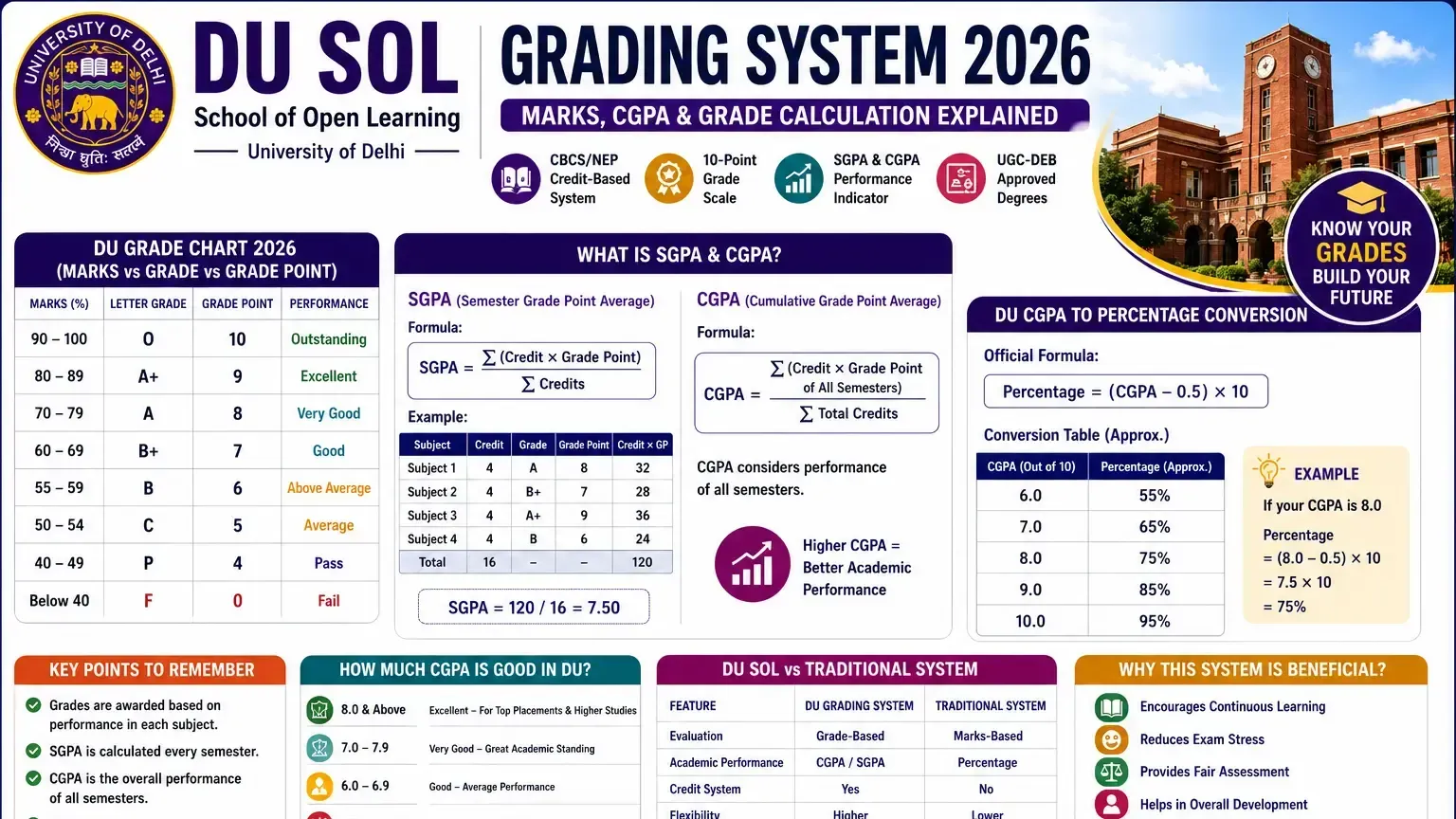
If you're a DU SOL student, chances are you've spent a good amount of time trying to figure out your DU CGPA to percentage — especially when a job form or admission portal suddenly asks for percentage instead of CGPA. It's a common confusion, and honestly, most students figure it out the hard way, right before a deadline. This guide walks you through the DU grade system step by step — how marks turn into grades, how SGPA and CGPA are worked out, and most importantly, how the DU CGPA to percentage formula actually works, so you're not scrambling to calculate it last minute.
What is the DU SOL Grading System?
What is DU SOL Grading System In the nutshell DU SOL grading is a method of tracking your academic progression in School of Open Learning, it's not the raw marks that are accounted for, instead the credit and grade points accumulated over semesters determine your performance. Although initially this may seem confusing for students, a clear look into the values makes the entire process easy and understandable, plus most of the students inDU SOL might definitely need their DU CGPA to percentage so it better to actually know the formula than to randomly type in random numbers in some random online converter.
Introduction to the CBCS/NEP Grading System
Delhi University follows the Choice Based Credit System (CBCS), with elements aligning with the National Education Policy (NEP) framework in select programmes. Every course carries a fixed number of credits, and your performance in each one gets converted into a grade point. These grade points, combined with credits, form the basis for calculating your SGPA and CGPA.
Why DU Uses a Grade-Based Evaluation System
Grades take some of the pressure off chasing exact marks. Instead of obsessing over whether you got 78 or 81, you land in a grade band, which honestly makes results a bit less stressful to look at. It also makes it easier to compare performance across subjects that may not have been equally difficult, before everything gets converted through the DU CGPA to percentage formula.
Difference Between Marks, SGPA, CGPA & Percentage
Marks are the raw scores you get in a single paper or exam. SGPA (Semester Grade Point Average) shows how you performed in one semester, based on credit-weighted grade points. CGPA (Cumulative Grade Point Average) reflects your overall performance across all semesters combined. Percentage is the converted value you get from CGPA using an official formula, mostly needed for job applications or higher education admissions.
Benefits of the DU Grading System
Gives a standardised way to measure performance across subjects One difficult paper doesn't drag your entire result down. Makes it easier to track your own improvement semester after semester. Widely accepted for competitive exams and further academic admissions
DU SOL Grading System 2026 Highlights
Particular | Details |
University | University of Delhi |
Institution | School of Open Learning (SOL) |
Evaluation System | CBCS/NEP Credit-Based |
Grade Scale | 10-Point Scale |
Performance Indicator | SGPA & CGPA |
Percentage Conversion | Official Formula |
Passing Criteria | As per University Guidelines |
DU Grade System 2026 Explained
The DU grade system assigns a specific grade point to a range of marks scored in each paper. These grade points, combined with subject credits, are what determine your final SGPA and CGPA.
What are Grade Points?
Think of grade points as a translation of your marks onto a 0–10 scale. The higher it is, the better you've done — and it directly shapes what your final DU CGPA to percentage turns out to be.
Grade Letters Used in DU
DU uses letter grades ranging from O (Outstanding) at the top to F (Fail) at the bottom, with A+, A, B+, B, C, and P filling in the range between.
Credit System Explained
Not every subject carries the same weight — core papers usually have more credits than elective or foundation courses. These credits get multiplied by your grade points, and that's what forms the base for SGPA and CGPA calculation.
Passing & Promotion Rules
You need to clear the minimum passing grade in both theory and internal assessment to get through a semester. Moving to the next semester usually depends on meeting minimum credit and attendance requirements set by the university.
DU Grade Chart (Marks vs Grade vs Grade Point)
Marks (%) | Letter Grade | Grade Point | Performance |
90–100 | O | 10 | Outstanding |
80–89 | A+ | 9 | Excellent |
70–79 | A | 8 | Very Good |
60–69 | B+ | 7 | Good |
55–59 | B | 6 | Above Average |
50–54 | C | 5 | Average |
40–49 | P | 4 | Pass |
Below 40 | F | 0 | Fail |
What is SGPA in DU?
SGPA is usually the first number you see when your semester result comes out, and it quietly becomes the foundation for your DU CGPA to percentage later.
Full Form of SGPA
SGPA stands for Semester Grade Point Average.
Importance of SGPA
It tells you how you did in that one semester. And since CGPA is built from your SGPA scores — and your DU CGPA to percentage from CGPA — keeping your SGPA steady each term genuinely makes a difference in the long run.
SGPA Formula
SGPA = Σ (Credit of Subject × Grade Point Earned) ÷ Σ (Total Credits of Semester)
Example of SGPA Calculation
Subject | Credit | Grade Point | Credit × Grade Point |
Subject A | 4 | 8 | 32 |
Subject B | 4 | 7 | 28 |
Subject C | 3 | 9 | 27 |
Subject D | 3 | 6 | 18 |
Total | 14 | — | 105 |
SGPA = 105 ÷ 14 = 7.5
What is CGPA in DU?
This is usually the number students actually care about — the one they'll eventually need to convert into a percentage when a job or admission form asks for it.
Full Form of CGPA
CGPA stands for Cumulative Grade Point Average.
Why CGPA Matters
CGPA signifies your steady performance throughout the course, not just one particular semester. For recruiters as well as educational institutions, it usually comes in handy when shortlisting profiles.
Difference Between SGPA & CGPA
SGPA is calculated for one semester, while CGPA is the cumulative average of all your SGPA values across completed semesters. In simple terms, SGPA is a part, CGPA is the whole.
How CGPA is Displayed on the Marksheet
Your CGPA is printed on the final marksheet or transcript issued once you complete the programme, along with the SGPA for each semester.
How is CGPA Calculated in DU?
A lot of students search "how is CGPA calculated in DU" simply because it's not a one-step process — a few things need to come together first before you land on your final DU CGPA to percentage.
Official CGPA Formula
CGPA = Σ (SGPA of each semester × Total Credits of that semester) ÷ Σ (Total Credits across all semesters)
Credit-Based Calculation Method
Since different semesters can carry a different number of credits depending on the subjects offered, this formula gives each semester appropriate weightage instead of treating them all equally.
Semester-wise Calculation
Each semester's SGPA is worked out on its own first. Once all semesters are done, these values are combined using the credit-weighted formula to arrive at your final CGPA.
Example with Credit & Grade Points
Semester | SGPA | Credits |
Semester 1 | 7.5 | 14 |
Semester 2 | 8.0 | 14 |
Semester 3 | 7.8 | 16 |
CGPA = [(7.5×14) + (8.0×14) + (7.8×16)] ÷ (14+14+16) CGPA = (105 + 112 + 124.8) ÷ 44 CGPA = 341.8 ÷ 44 = 7.77 (approx.)
DU CGPA to Percentage Conversion Formula
This is honestly one of the most searched queries about DU SOL difficulty for students, especially before applying for jobs or higher education, where percentage is often what's actually required instead of CGPA.
Official DU CGPA to Percentage Formula
Percentage = (CGPA – 0.5) × 10
Step-by-Step Percentage Calculation
Note down your final CGPA from the marksheet. Subtract 0.5 from it. Multiply the result by 10. That's your equivalent percentage.
Example 1
If CGPA = 7.5 Percentage = (7.5 – 0.5) × 10 = 70%
Example 2
If CGPA = 8.2 Percentage = (8.2 – 0.5) × 10 = 77%
DU CGPA to Percentage Conversion Table
CGPA | Percentage |
6.0 | 55% |
7.0 | 65% |
8.0 | 75% |
9.0 | 85% |
10.0 | 95% |
Students preparing for competitive exams or job applications can bookmark this DU CGPA to percentage table for quick reference instead of recalculating every time.
How Much CGPA is Good in DU?
"How much CGPA is good in DU" doesn't really have one fixed answer — it depends a lot on what you're actually using it for.
CGPA for Government Jobs
Most government job notifications ask for a minimum percentage, and a CGPA of 6.5 and above (roughly 65% equivalent) is generally considered a safe benchmark for eligibility.
CGPA for Higher Education
Generally, a CGPA score above 7.0 would be beneficial for both postgraduate admissions and entrance exams like competitive exams, but cutoffs differ from one institute to the other.
CGPA for Placements
A minimum CGPA of 7.0 or higher is typically desired by most recruiters across all fields, although interview rounds and your acquired skills carry the same weight as your mark sheet.
CGPA for Scholarships
Scholarship programs usually have an academic threshold, i.e., a CGPA ranging from 7.5 to 8.0.
Ideal CGPA Range
There's no fixed "ideal" number, honestly, but staying above 7.5 generally keeps you well-positioned for most academic and career opportunities without limiting your options.
DU SOL Passing Marks & Minimum CGPA Requirements
Theory Passing Marks
You generally need a minimum of 40% in theory papers to be considered as having passed that subject.
Practical Passing Marks (If Applicable)
For programmes with practical components, a separate minimum threshold applies to the practical assessment, on top of the theory requirement.
Assignment Passing Marks
Assignments carry their own minimum qualifying marks, counted separately before being added into your final result.
Overall Semester Requirements
To qualify for promotion into the next semester you must achieve the minimum passing grade for both the theory and internals sections of a subject, while also fulfilling the university's prescribed credit point structure.
Difference Between Marks, Percentage, SGPA & CGPA
Parameter | Marks | Percentage | SGPA | CGPA |
Definition | Raw score in a paper | Converted overall score | Semester performance average | Cumulative performance average |
Scope | Single subject | Overall course | One semester | All semesters combined |
Scale | Varies by paper | 0–100% | 0–10 | 0–10 |
Usage | Subject-level assessment | External applications | Semester tracking | Final academic record |
Looking for personalised guidance on DU SOL admissions or course selection? Distance education learning counsellors can help you understand your options based on your current academic standing.
DU SOL Grade Improvement & Revaluation
Can You Improve Your CGPA?
Yes, you can generally reappear for improvement exams in specific papers to raise your grade point, which in turn can improve your overall CGPA.
Revaluation Process
If you feel a paper wasn't checked properly, you can apply for revaluation within the window given after the Result Downloaded, as per university guidelines.
Improvement Exams
These let you retake a paper in a later attempt, with the better of the two scores usually considered for your final result, subject to university rules.
Back Paper Rules
If you don't clear a particular paper, you're usually given the chance to appear for it again as a back paper in the next examination cycle, so your degree doesn't get significantly delayed.
Common Mistakes While Calculating CGPA
Forgetting to factor in subject credits while averaging grade points, using the wrong grade point for the corresponding marks, applying the wrong percentage conversion formula, small rounding errors while calculating semester averages, mixing up SGPA with CGPA while checking results
Tips to Improve Your CGPA in DU SOL
Focus on Assignments
Since assignment marks add directly to your final result, putting in real effort here — instead of rushing through them — can meaningfully boost your overall score.
Prepare for Semester Exams
Steady preparation through the semester, rather than last-minute revision, tends to reflect better in your theory paper performance.
Attend PCP Classes
Personal Contact Programme (PCP) classes give you clarity on important topics and exam patterns, which can directly help you score better in theory papers.
Follow Previous Year Papers
Previously solved question papers make it easy for you to analyze the exam structure and identify important topics as well as time management during the exam hall.
Manage Credit-Heavy Subjects
Giving a bit more attention to subjects with higher credit value can have a bigger positive impact on your overall SGPA and CGPA compared to spreading your effort equally.
DU SOL Grading System vs Traditional Percentage System
Feature | DU Grading System | Traditional Marks System |
Evaluation | Grade-Based | Marks-Based |
Academic Performance | CGPA | Percentage |
Credit System | Yes | No |
Flexibility | Higher | Lower |
Conclusion
The DU SOL grading system 2026 uses a credit-based system and calculates SGPA and CGPA to judge students' results with transparency for the entire semesters. Knowing DU CGPA to percentage conversion, grading scale and calculations for results will be of great assistance for students when deciphering their results or seeking admission to a higher course. They should also verify with DU for the correct calculations on a regular basis.
For further help with DU SOL admissions, courses, or academic planning, distance education learning team is available to guide you through the process.