DU SOL Internal Assessment 2026: Marks Distribution, Weightage & Guidelines
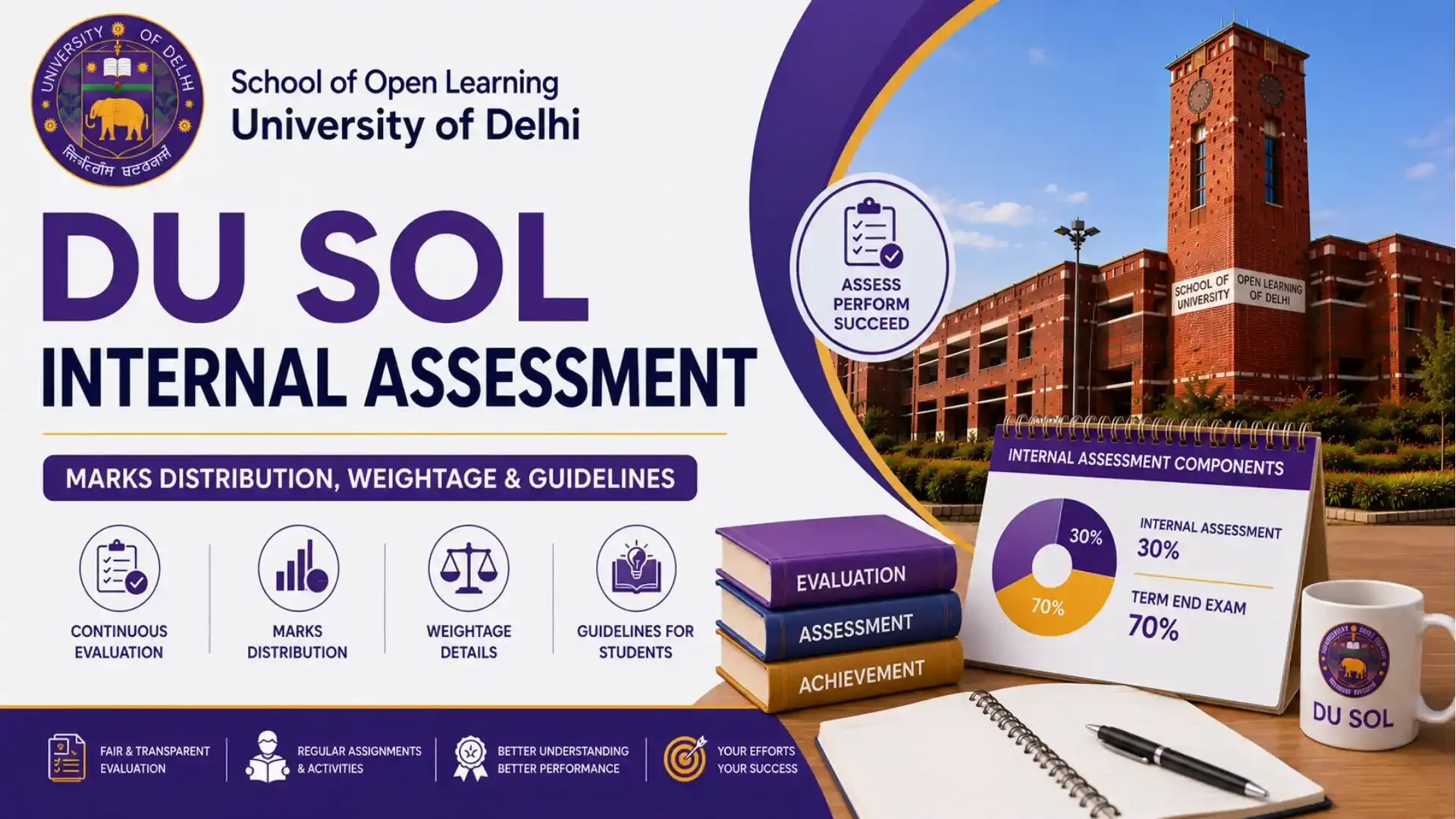
If you're a DU SOL student, you've probably heard seniors say "don't skip your internals" more than once — and there's a good reason for that. The DU SOL Internal Assessment 2026 isn't just a formality; it's a real chunk of your final marks that can quietly decide whether you pass or fail a paper. This guide from distance education learning walks you through the DU SOL internal assessment marks, DU SOL marks distribution, and how to make sure you don't lose easy marks by mistake.
DU SOL Internal Assessment 2026 Highlights
Particulars | Details |
Academic Session | 2025–26 |
Assessment Type | Continuous Internal Assessment (Assignments/Quizzes) |
Applicable Courses | UG and PG programmes under SOL |
Internal Assessment Weightage | 25 marks (out of 100 per paper) |
External Examination Weightage | 75 marks (Term-End Exam) |
Passing Criteria | Minimum 33% aggregate; minimum marks required in IA component |
Assignment Submission Mode | Online (portal upload) / Offline at study centre, as notified |
Evaluation Method | Assessed by subject examiners as per university guidelines |
What is DU SOL Internal Assessment?
Meaning of Internal Assessment
In simple terms, DU SOL Internal Assessment is the score you earn during the semester — through assignments, small tests, or projects — as opposed to what you get in the big term-end exam. Think of it as the university keeping an eye on your regular effort, not just your one-day exam performance.
Objectives of Continuous Evaluation
Nobody performs at their best on a single day, every time. That's the whole point of continuous evaluation — it doesn't put all the pressure on one exam. The internal assessment exists so that a student who studies steadily through the semester gets credit for that, rather than everything hinging on how the term-end paper goes.
Importance of Internal Assessment
Here's the part students often underestimate: your DU SOL internal assessment Grading System & CGPA get added directly to your DU SOL exam marks from the theory paper. So even if you're fairly confident about your final paper, ignoring your internals can still tank your result. It's worth treating this seriously rather than as an afterthought.
Courses Covered Under Internal Assessment
This system applies across most SOL programmes — BA, B.Com, MA, and others. That said, the exact structure isn't identical for every subject, so it's worth double-checking your specific syllabus rather than assuming it's the same as your friend's.
DU SOL Internal Assessment Marks Distribution
Component | Marks |
Internal Assessment | 25 |
Term-End Theory Exam | 75 |
Total | 100 |
This DU SOL marks distribution stays more or less the same across most UG and PG papers, which makes it easier to plan your semester around.
DU SOL Internal Assessment Weightage
Assessment Type | Weightage |
Internal Assessment | 25% |
End Semester Examination | 75% |
Components of DU SOL Internal Assessment
Assignments
For most papers, DU SOL assignments are the main event — subject-specific questions you answer within a set format and word limit.
Projects
Some papers, especially at the PG level, ask for a project instead of (or alongside) a regular assignment.
Practical Work
In science and applied courses, practical work often gets evaluated as its own piece of the internal score.
Presentations (If Applicable)
A few PG subjects may include a presentation or viva, though this isn't something every course requires.
Continuous Academic Performance
Examiners don't always look at just one submission in isolation — the overall consistency and quality of your work across the term can factor in too.
DU SOL Assignment Evaluation Process
Assignment Submission
Most assignments go through the official SOL portal as a PDF upload, though some subjects still allow offline submission at your study centre.
Evaluation Criteria
Basically, the question being asked has been answered; how have I answered it in a clear way, is there a format for answer writing for Exams, has the word limit been kept, these are things the examiner would consider in DU SOL evaluation. That is exactly the working behind the scene for Delhi DU SOL evaluation.
Marks Allocation
Your DU SOL assignment marks come out of that same 25-mark internal assessment total — there's no separate pool.
Result Declaration
Internal marks are typically uploaded before the final result comes out, and you can usually check them on your student login beforehand.
DU SOL Passing Marks Criteria
Component | Total Marks | Approximate Passing Requirement |
Internal Assessment | 25 | Minimum threshold applies |
Theory Exam | 75 | Minimum threshold applies |
Aggregate | 100 | Around 33% overall |
How DU SOL Internal Marks Are Calculated
Final Score Calculation
Component | Marks Obtained | Total Marks |
Internal Assessment | 18 | 25 |
Theory Exam | 40 | 75 |
Final Score | 58 | 100 |
Important Guidelines for Internal Assessment
Assignment Submission Rules
Every enrolled subject needs an assignment submission, formatted the way the university asks — roll number, subject name, and paper code included. These DU SOL assessment guidelines are usually spelled out clearly in the official notice.
Deadlines
These deadlines aren't flexible in most cases. Miss the window, and your assignment usually won't be accepted after that, so it pays to keep an eye on notified dates.
Plagiarism Policy
Copy-pasted content gets flagged during evaluation and costs you marks — or worse, gets your submission rejected outright. Write it in your own words.
Attendance Requirements (If Applicable)
SOL is mostly a distance-learning setup, but a few courses with practical or contact sessions may tie some internal evaluation to attendance.
Evaluation Transparency
Once your marks are uploaded, you can usually check your internal assessment status on the portal — useful if you ever need to flag something that looks off.
Common Reasons for Losing Internal Marks
Late Assignment Submission
Miss the deadline, and those marks are often gone for good.
Incomplete Assignments
Leaving questions half-answered brings your score down fast.
Plagiarism
Copied content gets caught during evaluation and marked down.
Incorrect File Upload
Wrong subject file or a corrupted document can mean rejection.
Missing Project Submission
Skipping a required project or practical directly hits your internal score.
How to Improve Your Internal Assessment Score
Submit Assignments on Time
Don't wait till the last hour — portal issues happen right when you can least afford them.
Follow University Guidelines
Stick to the word limit, format, and paper code exactly as specified.
Write Original Answers
Use your own understanding instead of lifting content from the internet or a classmate.
Keep Proper Documentation
Hold on to your submission receipts and soft copies, just in case.
Track Assignment Status
Check the portal now and then to confirm your submission actually went through.
Not sure how to plan your semester around all this? Distance education learning counsellors can walk you through your DU SOL internal assessment marks, deadlines, and evaluation process so you stay ahead all semester.
Internal Assessment vs External Examination
Parameter | Internal Assessment | External Examination |
Conducted By | University/Department | University |
Marks Weightage | 25 marks | 75 marks |
Evaluation | Continuous | End Semester |
Submission | Assignment/Project | Written Exam |
Common Mistakes Students Should Avoid
Ignoring Assignment Instructions
Skimming the question paper instead of reading it properly often leads to answers that miss the point entirely — even if they're well written.
Missing Submission Deadlines
Don't bank on an extension. DU SOL deadlines are usually firm, and "I thought there'd be more time" isn't a great excuse.
Uploading Wrong Files
A quick double-check of the subject and paper code before hitting upload saves a lot of headache later.
Not Checking Submission Status
Assuming your file uploaded fine without actually confirming it is a common — and avoidable — mistake.
Copying Content
Lifted content, whether from the internet or a friend's assignment, is easy for examiners to spot and gets penalised.
DU SOL Internal Assessment Timeline 2026
Assignment Release
Assignments usually drop a few weeks before term-end exams begin, announced through official notices on the SOL website.
Submission Window
You'll typically get about one to two weeks to complete and submit your work.
Evaluation Period
After submission, examiners take a few weeks to go through and evaluate the assignments.
Internal Marks Upload
Marks are uploaded to the portal before the final result gets compiled.
Final Result Preparation
Results are only finalised once both your internal and theory marks are combined.
Stage | Approximate Timing |
Assignment Release | 3–4 weeks before term-end exams |
Submission Window | 1–2 weeks |
Evaluation Period | 2–3 weeks post-submission |
Internal Marks Upload | Before result declaration |
Final Result Preparation | After both components are finalised |
Conclusion
At the end of the day, DU SOL Internal Assessment 2026 is one of those small-looking things which ends up not being small at all. Though 25 marks seem relatively insignificant to most of us, it has led to the decided outcomes for numerous candidates across years. So, be aware of the DU SOL marks distribution, adhere to the given assessment parameters, and don't wait up until the last hour to submit assignments. We at Distance Education Learning are available at your service if you're looking for assistance to help you throughout the entire process.